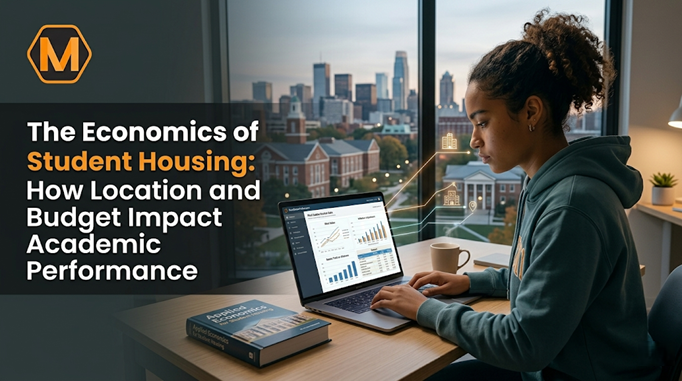

The transition to university life is often framed as an academic milestone, but for the modern undergraduate, it is equally a lesson in real estate and financial management. As tuition fees stabilize in some regions but climb in others, the most volatile variable in the “cost of degree” equation has become housing. Whether you are hunting for a studio in London, a shared apartment in New York, or a purpose-built student room in Sydney, the roof over your head dictates more than just your sleep schedule—it fundamentally shapes your GPA.
Finding a balance between a manageable budget and a productive environment is the ultimate student challenge. Many students find that the pressure of managing high rental costs and complex lease agreements can lead to significant academic stress. When the logistics of moving and financial planning become overwhelming, seeking professional assignment help can provide the necessary breathing room to focus on securing a quality living situation without letting grades slip. By offloading some of the heavy academic lifting, students can dedicate the time needed to research neighborhoods, compare utility costs, and negotiate better rental terms.
The Proximity vs. Price Paradox
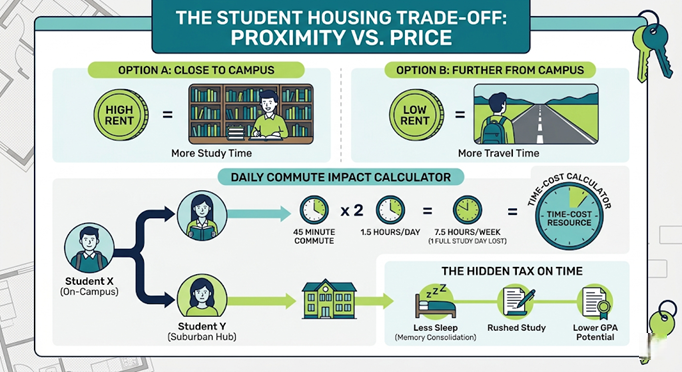
Every student faces the same dilemma during their sophomore or junior year: do you live on the doorstep of the campus library for a premium price, or do you move three miles out to save $400 a month? This is the “Proximity vs. Price Paradox.”
While living further away seems like a financial win, it introduces a “hidden tax” on your time. A 45-minute commute twice a day adds up to 7.5 hours a week—essentially a full day of productivity lost to transit. For students in high-intensity programs like STEM or Healthcare, this lost time can be the difference between a thorough revision and a rushed submission.
The Impact of Living Conditions on Cognitive Load
It isn’t just about the distance; it’s about the environment. Low-cost housing often comes with trade-offs:
- Noise Pollution: Thin walls in overcrowded apartments can disrupt REM sleep, which is critical for memory consolidation.
- Infrastructure: Poor Wi-Fi or lack of dedicated study space forces students to spend more time in crowded public libraries.
- Security: Feeling unsafe in a neighborhood increases cortisol levels, which is scientifically proven to impair cognitive function and focus.
Budgeting for Success: A Comparative Look at Student Costs
To understand the global landscape of student housing, we must look at how different markets affect a student’s monthly “burn rate.” Below is a snapshot of average costs and their impact on academic lifestyle.
Student Housing ROI Matrix
| City Type | Avg. Monthly Rent (USD) | Commute Impact | Social Connectivity | Academic Focus Level |
| High-Density (NY/London) | $1,200 – $1,800 | High (Subway/Tube) | Very High | Moderate (Distraction heavy) |
| University Town (Oxford/Ann Arbor) | $800 – $1,200 | Low (Walking/Bike) | High | High (Study-centric) |
| Suburban Hubs | $500 – $800 | Very High (Bus/Car) | Moderate | Variable |
Using Data to Navigate the Market
In 2026, the real estate market is driven by data. For a student, understanding “rental yield,” “inflation-adjusted costs,” and “utility forecasting” isn’t just for business majors—it’s a survival skill. When you are looking at a lease, you aren’t just looking at a price tag; you are looking at a statistical model of your future expenses.
Interpreting these trends can be daunting, especially when your primary focus is your degree. If you find yourself struggling to analyze market trends or complex data sets for your coursework, getting statistics Homework help from experts at MyAssignmentHelp Services can ensure that your data analysis is accurate and professionally presented. This type of support allows you to master the analytical side of your studies while applying those same logical skills to your real-life housing decisions.
Having a solid grasp of statistics helps you see past the marketing jargon of “luxury student living.” You can calculate the true cost per square foot and determine if the “free gym” included in the rent is actually worth the $100 monthly markup compared to a standard apartment and a $20 local gym membership.
The Psychological Toll of Financial “Rent Burden”
The term “rent burdened” refers to households that spend more than 30% of their income on housing. For students living on loans or part-time wages, this percentage often spikes to 50% or 60%.
When such a large portion of your mental energy is spent worrying about the next rent check, your “bandwidth” for learning shrinks. This is known as the scarcity mindset. When we are obsessed with a lack of resources (money or time), our brain’s executive function takes a hit.
Strategies to Mitigate Housing Stress:
- The Shared Economy: Co-living spaces are becoming more popular. Sharing a kitchen and common area but having a private bedroom can save up to 25% on costs while providing a built-in study group.
- Guarantor Services: For international students, finding a guarantor can be a hurdle. Start this process early to avoid last-minute “emergency” rentals that are overpriced.
- Utility Inclusion: Always prioritize “all-bills-included” contracts. It makes budgeting predictable and eliminates the stress of fluctuating heating costs in the winter.
Location and the “Academic Ecosystem”
Your location defines your network. Living in a hub with other students creates an “academic ecosystem.” Being able to walk across the hall to ask a classmate a question about a lecture is an undervalued asset.
However, there is a rising trend of “Remote Scholars”—students who choose to live in significantly cheaper, rural areas and commute only for essential labs or exams. This works well for those with high self-discipline, but it requires a robust digital setup. If your home internet is slow or your environment is distracting, the $300 you save on rent might cost you a letter grade.
Conclusion: Investing in Your Environment
Ultimately, student housing is not just an expense; it is an investment in your academic performance. A quiet, well-lit, and secure room is a tool, much like a laptop or a textbook. While it is tempting to pick the cheapest possible option to save money, the long-term cost of a poor living environment—manifesting in lower grades, higher stress, and poor health—can far outweigh the initial savings.
By taking a data-driven approach to your housing search and ensuring you have the academic support systems in place to manage your workload, you can turn your living situation into a springboard for success rather than a hurdle to overcome.
Frequently Asked Questions (FAQ)
1. How much of my budget should go toward rent?
Ans: Ideally, housing should not exceed 30% to 40% of your total monthly allowance. If it exceeds 50%, you are “severely rent-burdened,” which usually leads to increased stress and a need to work more hours, potentially hurting your studies.
2. Is it better to live on-campus or off-campus for grades?
Ans: Statistically, first-year students often perform better on-campus due to easy access to resources. However, by the third year, many students find that the independence and quiet of a well-chosen off-campus apartment better suits their advanced study needs.
3. What are the “hidden costs” of student housing?
Ans: Beyond rent, remember to budget for:
- Security deposits (usually 1 month’s rent).
- High-speed internet (essential for modern degrees).
- Commuting costs (bus passes or fuel).
- Laundry fees if facilities aren’t in-unit.
4. How can I improve my study environment in a noisy apartment?
Ans: Invest in noise-canceling headphones, use “white noise” machines, and try to synchronize your deep-work hours with the times your roommates are out at class or work.
5. Does the quality of my housing really affect my GPA?
Ans: Yes. Studies consistently show that housing instability, poor lighting, and lack of thermal comfort (being too cold or hot) are directly correlated with lower cognitive performance and higher dropout rates.
About The Author
I am Min Seow, a digital strategist and academic consultant dedicated to helping university students navigate the complex intersection of financial literacy and higher education. My work focuses on empowering undergraduates to make data-driven decisions, whether they are managing a rental budget or tackling advanced analytical coursework.